
Top Destinations
Travelers' Choice

Beyond Expeditions. Beyond Business.
Beyond Imagination.
Top Destinations
Travelers' Choice
Beyond Expeditions. Beyond Business.
Beyond Imagination.
Beyond Expeditions. Beyond Business.
Beyond Imagination.
Beyond Expeditions. Beyond Business.
Beyond Imagination.
On 20th August, 2023, one of India's popular news agency “The Print” published an article about Lhuentse as Bhutan’s treasures of history, culture and natural splendor.
Lhuentse, located in the remote northeast of Bhutan, is renowned for its dramatic landscapes, sacred sites, and deep-rooted traditions. The district is often regarded as a cultural heartland, known especially for its fine textiles and ancestral links to Bhutan’s royal lineage. Its rugged terrain, ancient monasteries, and vibrant weaving villages reflect a region where heritage remains strongly preserved.
Despite its remoteness, Lhuentse continues to captivate visitors with its authenticity, natural beauty, and spiritual significance.

Singye Dzong, often described as one of Bhutan’s most sacred and mystical sites, holds exceptional spiritual, cultural, and historical value. Located in the remote highlands of Lhuentse, the site is deeply associated with Guru Rinpoche (Padmasambhava), who, according to Bhutanese tradition, meditated here in the 8th century to subdue negative forces obstructing the spread of Buddhism. The name “Singye Dzong,” meaning Lion Fortress, derives from the belief that Guru Rinpoche manifested in a wrathful lion-headed form to conquer these obstacles, imprinting the place with profound spiritual power.
Reaching Singye Dzong requires a demanding multi-day trek through pristine forests, alpine meadows, and sacred lakes, which adds to its aura of remoteness and sanctity. Pilgrims and trekkers often describe the journey as both physically challenging and spiritually transformative. Scattered around the area are sacred caves, meditation spots, and rock formations considered to be natural dzongs, believed to hold blessings capable of purifying past karma and fulfilling heartfelt prayers.
Today, Singye Dzong is not only a pilgrimage destination but also a vibrant spiritual center. A Drupdey (meditation retreat) is maintained there, where monks undertake rigorous three-year meditation cycles in complete seclusion. Local communities and conservation authorities have also upgraded trails and basic facilities to support sustainable pilgrimage tourism.
With its dramatic landscape, legendary origins, and enduring spiritual significance, Singye Dzong remains one of Bhutan’s most revered heritage sites—an embodiment of devotion, resilience, and the deep-rooted Buddhist identity of Lhuentse.

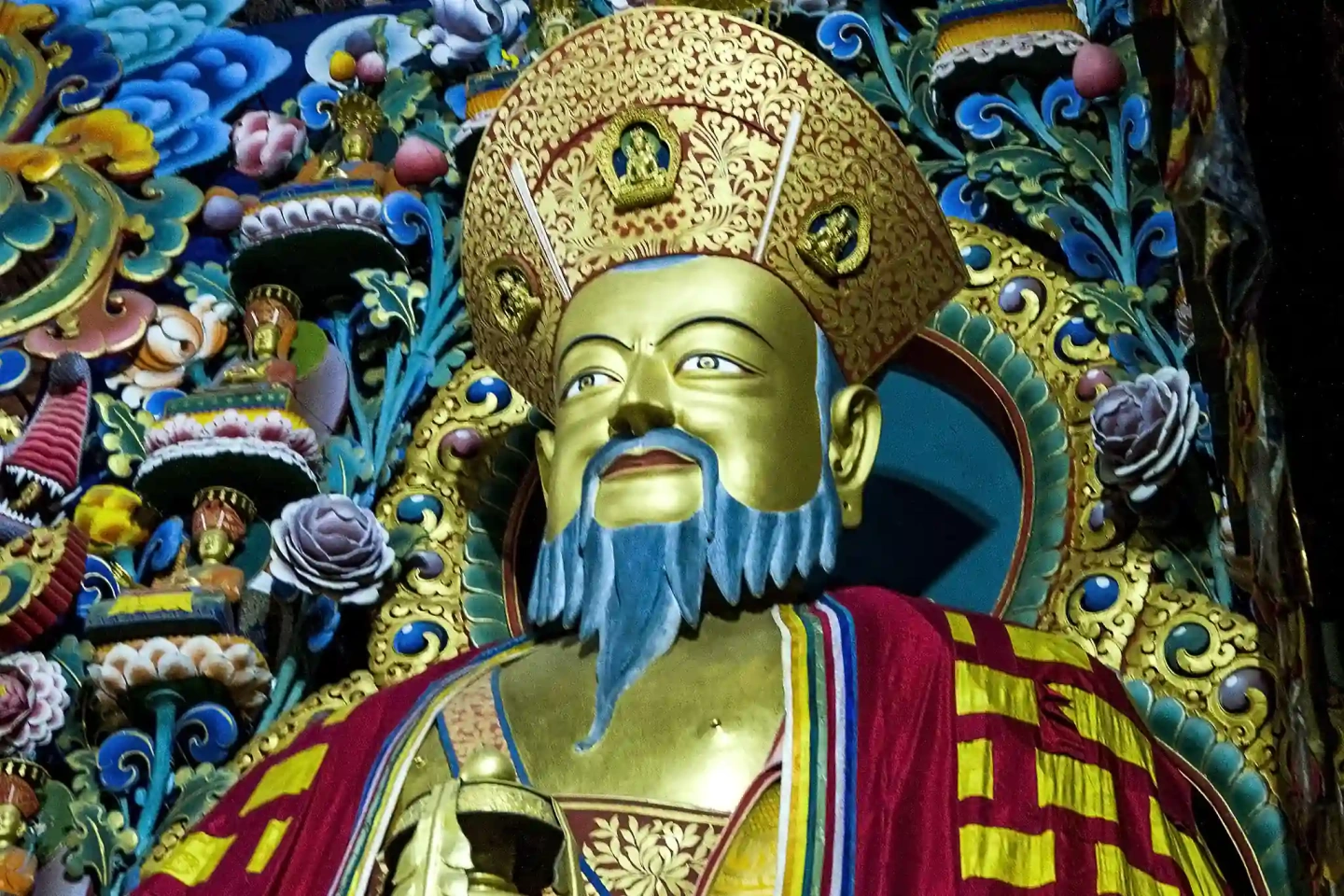
In the hills of Takila, Lhuentse, a monumental statue of Guru Padmasambhava rises like a beacon of peace and prophecy—the 154‑ft “Guru Nangsa Zelnen” stands as a deeply meaningful symbol of Bhutan’s spiritual heritage.
History & Background
The idea to build this giant statue was inspired by prophetic visions: Terton Lerab Lingpa (1856–1926), a revered Bhutanese treasure-revealer, predicted that a statue of Guru Rinpoche (Padmasambhava) should be erected in Takila to avert a “war of horses” in the Kurtoe Valley. Similarly, Lama Sonam Zangpo, a famed 20th‑century Bhutanese yogi, supported the vision, stating that such a monument would promote peace and harmony in Bhutan and the wider world. Construction began in March 2008 under the leadership of Khenpo Karpo Rinpoche and was funded by the Druk Odiyana Foundation. The statue was officially consecrated in 2015 after years of building work.
The statue stands at approximately 154 feet (about 47 m) tall, making it one of the tallest representations of Guru Padmasambhava in the world. It is situated on a hill overlooking the Tangmachu (Tang‑mchu) Valley, giving it a commanding, sacred presence.
Surrounding the main figure are eight large stupas, as well as 108 smaller stupas. These stupas are arranged to represent a mandala, symbolising the cosmos with Guru Rinpoche at its spiritual center. Inside the statue are relics: notably, a vajra (a ritual thunderbolt) believed to be associated with Guru Rinpoche, plus other consecrated items.
Significance & Purpose
Spiritual and Prophetic Importance: The statue was built to fulfill the prophecy of Terton Lerab Lingpa and the vision of Lama Sonam Zangpo. For many, it is not just a work of art, but a living manifestation of predictions meant to safeguard the region and bring positive energies.
Pilgrimage Site: It has become a major destination for devotees, monks, and spiritual seekers who come to pay respects, meditate, or perform rituals.
Cultural & Economic Role: According to the Lhuentse dzongkhag administration, the site is envisioned not only as a place of worship but also as a “sacred learning center” and possibly a home for elders. Lhuentse Dzongkhag This means the statue is also seen as a future hub for religious education and community welfare.
Symbol of Peace and Unity: By manifesting a prophetic vision, the statue symbolizes Bhutan’s commitment to spiritual traditions and its aspiration for peace, stability, and harmony—locally and globally.
In summary, the Takila Guru Statue stands as an awe-inspiring symbol of Bhutan’s spiritual devotion, prophetic heritage, and commitment to peace. It is a place where myth and reality meet, inviting pilgrims and travelers alike into an experience of profound faith, cultural identity, and sacred landscape.

In the quiet hills of Lhuentse, every thread tells a story—Khoma Village is where Bhutan’s most exquisite silk textiles come to life.
Khoma is a small, remote settlement celebrated as the birthplace and spiritual home of Kishuthara, the country’s finest silk weaving tradition. Its relative isolation has allowed generations of artisans to preserve the intricate techniques and vibrant patterns that make the textiles unique.
History & Cultural Significance
Weaving in Khoma is more than a craft; it is a cultural identity. Girls learn to weave from an early age, often under the guidance of their mothers or grandmothers, continuing traditions passed down through centuries. The signature Kishuthara kira, a richly patterned silk garment, is widely regarded as one of Bhutan’s most elegant traditional outfits. Historically, the textiles were dyed using natural plant-based pigments, although today some commercial threads are also used. Despite modernization, many weavers are reviving traditional dyeing methods to maintain authenticity and environmental sustainability.
Khoma Village attracts visitors for multiple reasons. Its weaving tradition represents the pinnacle of Bhutanese craftsmanship, and travelers can observe artisans at work on traditional looms. The village also provides insight into rural Bhutanese life, where art, family, and community intertwine. For cultural tourists, owning a Khoma silk piece is more than a souvenir—it is a connection to centuries of heritage. Additionally, the village’s scenic surroundings, with rolling hills and terraced fields, enhance the experience, making it a destination that combines natural beauty with artistic excellence.
While the village faces challenges such as limited infrastructure and market access, efforts are being made to support sustainable tourism and cultural preservation. Small initiatives, like community-based homestays and guided weaving tours, allow visitors to engage with the craft respectfully, helping Khoma retain its traditional charm while benefiting economically.
Khoma Village stands today as a living testament to Bhutan’s artistic legacy—a place where every loom and every silk thread carries the story of a community, a culture, and a nation.